
The Curiosity Mars Rover is now smart enough to pick its own targets for exploration, according to a new study.

Written by Jesse Emspak
The Curiosity Mars Rover is now smart enough to pick its own targets for exploration, according to a new study.
Written by Dr. Craig Idso

In an intriguing new paper published in the journal Marine Ecology Progress Series, Zimmerman et al. (2017) investigate the controversial topic of ocean acidification, or as they more correctly describe it, ocean carbonation.*
Written by SHANIKA GUNARATNA

Solar energy is running into a pesky problem: air pollution worldwide.
Written by Tom Regan

Whether it’s using AI to help organize a Lego collection or relying on an algorithm to protect our cities, deep learning neural networks seemingly become more impressive and complex each day. Now, however, some scientists are pushing the capabilities of these algorithms to a whole new level – they’re trying to use them to read minds.
Written by Alan Siddons

With all the talk about CO2 and global warming today, it’s odd that the heating mechanism to blame for this concern – the Greenhouse Effect – is seldom contemplated or discussed. Rather, it’s taken for granted.
Written by Tony Heller
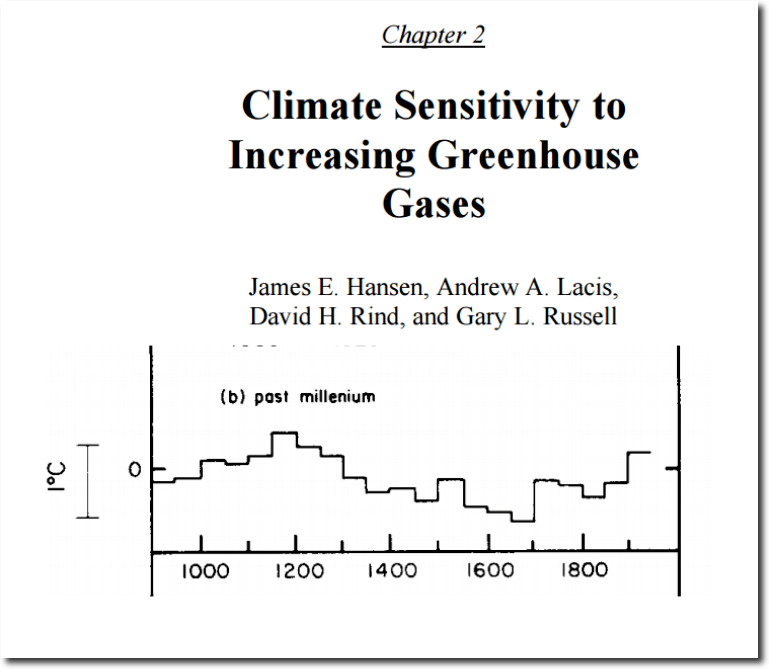
In 1981, NASA’s James Hansen showed a Medieval Warm Period – based on temperatures in Greenland, California, and England.
Written by Erin Ross

Parasitic wasps use their venom to turn unsuspecting insects into incubators for their young, but it’s unclear how such a diverse, widespread group of insects evolved specialized poison to hijack their hosts. A new study of wasps’ venom-producing genes found they primarily code for something else, and that the insects lead a genetic double-life.
Written by University of Southampton

Dinosaurs’ faces might have been much more sensitive than previously thought, according to a University of Southampton study – helping them with everything from picking the flesh from bones to wooing potential mates.
Written by Nature Editorial

Seven years ago, a cover of The Economist showed Barack Obama, head down on a Louisiana beach in front of an oil rig — the picture of lonely despair. The image perfectly encapsulated the news magazine’s story about the massive pollution caused when BP’s Deepwater Horizon platform exploded, and what the president of the United States could possibly hope to do about it. But Obama was not alone when the picture was taken.
Written by Brooks Hays

Water is often the focus of NASA’s many Martian scientific missions. It’s true, Mars was once a surprisingly watery world. But it also once featured large amounts of magmatic activity.
Written by Annie Sneed

In spite all the harm and havoc volcanic eruptions can wreak—even the nonfatal ones—scientists still cannot reliably forecast them. Although they have had success predicting dozens of eruptions, they lack a standard method.
Written by Andrew Follett

Technology to capture and store carbon dioxide (CO2) is too expensive and will “never be viable,” according to a former World Bank adviser.
Written by Mariëtte Le Roux

Feathered dinosaurs that walked on two legs and had parrot-like beaks shared another characteristic with modern birds—they brooded clutches of eggs at a temperature similar to chickens, a study showed Wednesday.
Written by Brooke James

An artificial network was able to detect rare, super-fast stars through the Milky Way, thanks to an AI that was collecting data from the European Space Agency’s Gaia probe.
Written by Jonathan Amos

European aerospace giant Airbus and its partner, OneWeb, have begun the production of a satellite mega-constellation.
Written by Brid-Aine Parnell

In a ground-breaking study over ten years in the making, scientists have observed two supermassive black holes orbiting each other hundreds of millions of light years from Earth.