
Gates’ ‘Green Revolution’ Wikipedia Page Edited To Remove Criticism

An investigation by Claire Wilmot for the Bureau of Investigative Journalism detailed how consultants working for the London public relations firm Portland Communications secretly edited the Wikipedia page for the Gates Foundation’s controversial “Green Revolution” initiative to remove criticism and independent evaluations about the performance of the billion-dollar organization
Powerful institutions are using covert tactics to shape how they are portrayed online. One method involves deploying fake “sockpuppet” accounts to edit Wikipedia pages, enabling interested parties to quietly remove criticism or rewrite how organizations are described on one of the world’s most widely used sources of information.
A British investigation found that such tactics were used to remove critical information about AGRA (formerly the Alliance for a Green Revolution in Africa), a controversial initiative backed by the Gates Foundation that seeks to industrialize African food and farming systems.
The investigation by Claire Wilmot for the Bureau of Investigative Journalism details how consultants working for the London public relations firm Portland Communications secretly edited AGRA’s Wikipedia page to remove criticism and independent evaluations about the performance of the billion-dollar organization.
The analysis identified a “network of 26 ‘sockpuppets’ — multiple accounts orchestrated by a single person — that was eventually banned from Wikipedia under suspicion of paid editing,” Wilmot wrote.
Wikipedia reverted the edits after the violations were exposed.
But the findings highlight growing concerns about attempts by governments, corporations and philanthropies to influence widely used online information sources that increasingly feed search engines and artificial intelligence systems that summarize information for the public.
Sockpuppet accounts used to edit AGRA page
The Gates Foundation-funded AGRA effort has been widely criticized by African groups and others who say the foundation’s push for chemical-intensive monoculture farming and export-oriented commodity crops is exacerbating hunger, worsening inequality and entrenching corporate power in the world’s hungriest region.
In 2020 and 2021, sockpuppet accounts linked to Web3 Consulting — a firm Portland Communications used to outsource its “Wikilaundering” work — made significant edits to the AGRA page.
Both AGRA and the Gates Foundation have worked with Portland Communications, Wilmot reported.
Among its edits, the sockpuppets:
- Eliminated an entire section summarizing evaluations and critiques of AGRA.
- Deleted references to research showing AGRA failed to meet its own goals.
- Altered the timeline of AGRA’s stated deadlines and targets.
- Replaced critical material with promotional language or AGRA-produced publications.
In one example, a sock-puppet editor removed a reference to a 2020 paper by Tufts University researcher Timothy Wise (who has also written for U.S. Right to Know).
Wise analyzed national agricultural data from African countries participating in AGRA programs and reported that the initiative failed to meet its stated goals of reducing hunger and doubling productivity and incomes for 30 million small-scale farmers, despite nearly $1 billion in philanthropic funding and billions more in government subsidies for commercial seeds and agrichemicals in AGRA’s target countries.
The number of hungry people in those countries rose by about 30 percent since the Gates program began.
Wikipedia’s display of past edits to its pages allows readers to review such changes:

Sockpuppets also changed the target date and details of AGRA’s goals:

Wikipedia reverted the edits after Wilmot exposed the violations. “I think Wikipedia editors deserve a huge amount of credit,” Wilmot said. “They took our findings and integrated them into the relevant pages quite quickly, and on the AGRA page, they made sure that the research that was removed was put back up.”
AGRA Wikilaundering was among ‘most egregious’
Wilmot’s investigation found that Portland subcontractors had also “polished the public image of Qatar by burying references to critical reporting ahead of the 2022 World Cup” and “obscured mentions of a major terrorist-financing case involving Qatari businessmen.”
But she said the changes to AGRA’s page stood out as a clear example of “Wikilaundering.”
“In my reading of all the edits that were made by this particular network, the removal of well-sourced information on AGRA’s page was among the most egregious examples of Wikilaundering that we saw,” Wilmot told Wise. “It had the effect of misrepresenting AGRA’s achievements and erasing legitimate, research-based criticism of its program.”
Wilmot received no response from the Gates Foundation regarding her findings. An AGRA spokesperson confirmed that AGRA had hired Portland but said AGRA had “no knowledge of, nor any association with, Web3 Consulting,” and that AGRA is committed to transparency and its policies prohibit any actions that violate the terms of service of external platforms.
More AGRA critiques removed
After reading Wilmot’s analysis, Wise conducted more searches on the AGRA Wikipedia page and found another suspicious change.
In July 2021, an unidentified editor that Wilmot did not link to the Web3 network deleted a long section of “Critiques” on the page that referenced a wide range of sources who criticized AGRA for supporting genetically modified crops, favoring export crops over local crops and promoting monocrop farming that increases dependence on chemical inputs.
That editor also removed a perspective that the Gates Foundation’s “influence on media and global health was so great it could chill almost all criticism.”
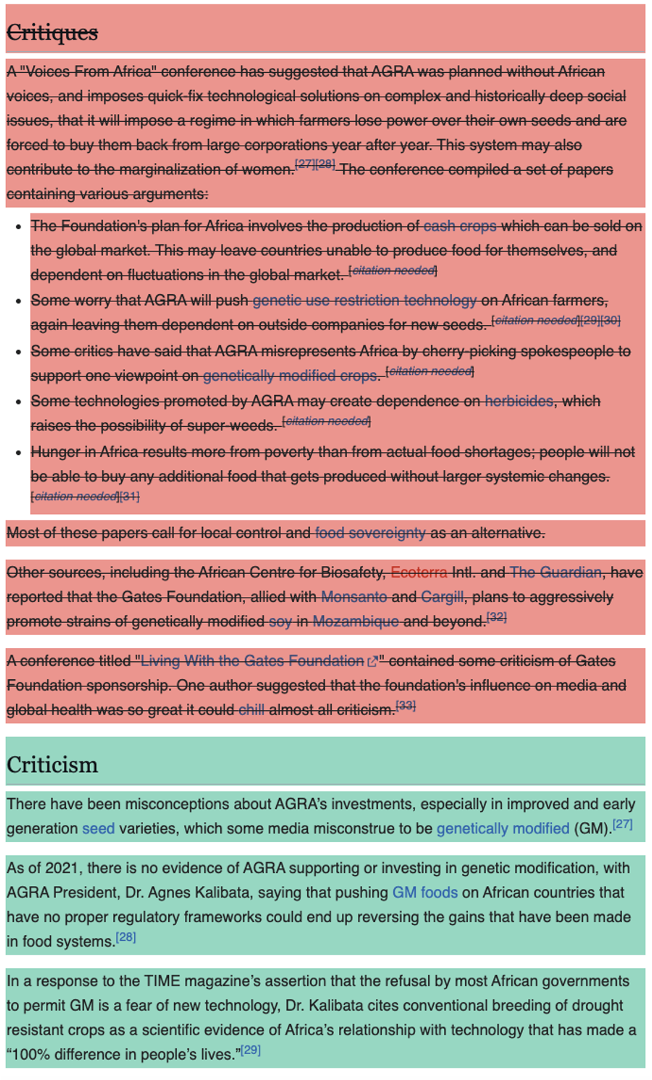
Wikipedia’s editors, who had become suspicious of paid or promotional changes to the AGRA page, reverted the edit to the original content on the same day, according to time stamps on the changes.
When reached for comment, the Gates Foundation media relations department told Wise the foundation “was not involved in any effort to edit Wikipedia pages related to AGRA.”
An AGRA spokesperson responded that “any authorised updates to Wikipedia profiles on AGRA were intended to be and handled by our internal communications team to ensure accurate and up-to-date organisational information is available. As Wikipedia is a public platform, we would not be in a position to account for all the edits made to the page in question.”
Read more in Wise’s article in The Elephant, “AGRA Exposed for Censoring Criticism of its Green Revolution.”
Why Wikipedia manipulation matters
Wikipedia has become one of the most influential sources of information on the internet. Its articles frequently appear at the top of search results and are increasingly used to train artificial intelligence systems and generate automated summaries.
“Because it’s widely used by search engines and AI systems, efforts to manipulate it can have far-reaching effects,” Wilmot said. For that reason, Wikipedia’s rules prohibit organizations or paid consultants from directly editing pages about themselves.
But Wilmot warned that the network uncovered in the probe likely represents only a small part of broader efforts by powerful institutions to sanitize their online reputations.
Read more of our reporting on Bill Gates, the Gates Foundation and their influence over food systems and African agriculture.
See more here childrenshealthdefense.org